FAQ Section
01.
What are dedicated connectivity services and how do they differ from a standard Internet connection?
-
Dedicated connectivity services are private, point-to-point or multi-site connections with capacity reserved for one organization. Unlike public internet connections that share resources with other users, dedicated channels guarantee a fixed amount of bandwidth reserved for your organization. They come with SLAs covering availability, latency, and performance.
02.
What benefits do dedicated channels provide for businesses?
+
Predictable performance, traffic isolation, defined bandwidth, route control, and SLA-backed availability. Dedicated channels are designed for workloads where downtime, latency variation, or shared bandwidth would create real business risk. For business-critical and transactional operations, they also reduce the risk of lost or interrupted transactions that can occur over standard internet connections without guaranteed performance or a defined route.
03.
How secure are dedicated channels?
+
Dedicated channels keep your traffic on private paths separated from the public internet. They support encryption—including MAC encryption where it is required by the service model—network segmentation and traffic separation mandated by compliance requirements. Pseudowire channels provide an additional layer of isolation by encapsulating traffic as a point-to-point private circuit. The exact controls depend on the service model: IPLC, EPL, EoMPLS Pseudowire, MPLS L2 or L3 VPN.
04.
I need global presence. Can I get IPTP addresses in specific regions like Asia and Latin America?
+
Yes. IPTP Networks can help you establish a network presence in the regions where your business operates. We work with you to identify the right IP addressing and routing options for your geography, in line with applicable regional requirements. For more details on IP address services,
see our IPv4/IPv6 Services page.
05.
What types of dedicated connectivity services does IPTP Networks offer, and how do I choose the right one?
+
We offer MPLS L3 VPN for multi-site enterprise WAN, IPLC for international point-to-point connectivity, EPL for transparent Ethernet private lines, and EoMPLS for Ethernet services over MPLS. The right choice depends on geography, latency, security, and scalability needs. Our engineers help match the service to your design. For a detailed overview of EPL, see the IPTP article
“What is EPL”.
06.
How do you help us choose between L1, L2, and L3?
+We start from your use case, locations, and SLA targets and map them to the right layer: L1 for deterministic point-to-point links (often international), L2 for Ethernet transparency such as DC interconnect or VLAN extension, and L3 for multi-site private WAN with managed routing and QoS. You receive a clear recommendation with a proposed design.
07.
What affects pricing?
+The transport layer and service model (L1, L2, or L3) is one of the most significant pricing factors, as it determines the level of traffic isolation, transparency, and engineering complexity. Other factors include: geography and distance, last-mile availability at each site, port and committed capacity, required redundancy, SLA level (availability, restoration, performance, and reporting), and contract term.
08.
Can we combine MPLS with Internet or 4G/5G backup?
+Yes. Hybrid is common: MPLS carries critical traffic that needs predictable performance, while Internet and/or 4G/5G provides backup or carries non-critical traffic. Failover behaviour and traffic priorities are designed so the service behaves predictably during transitions.
09.
Where does the SLA apply: access, backbone, or cloud?
+The SLA (Service Level Agreement) covers the parts of the service we deliver and operate: access/last-mile when in scope, and our backbone. For cloud, the SLA typically applies up to the interconnect or on-ramp hand-off; performance inside the cloud provider’s network follows the provider’s own SLA. The customer LAN is covered only when included as a managed scope.
10.
What is the typical provisioning time?
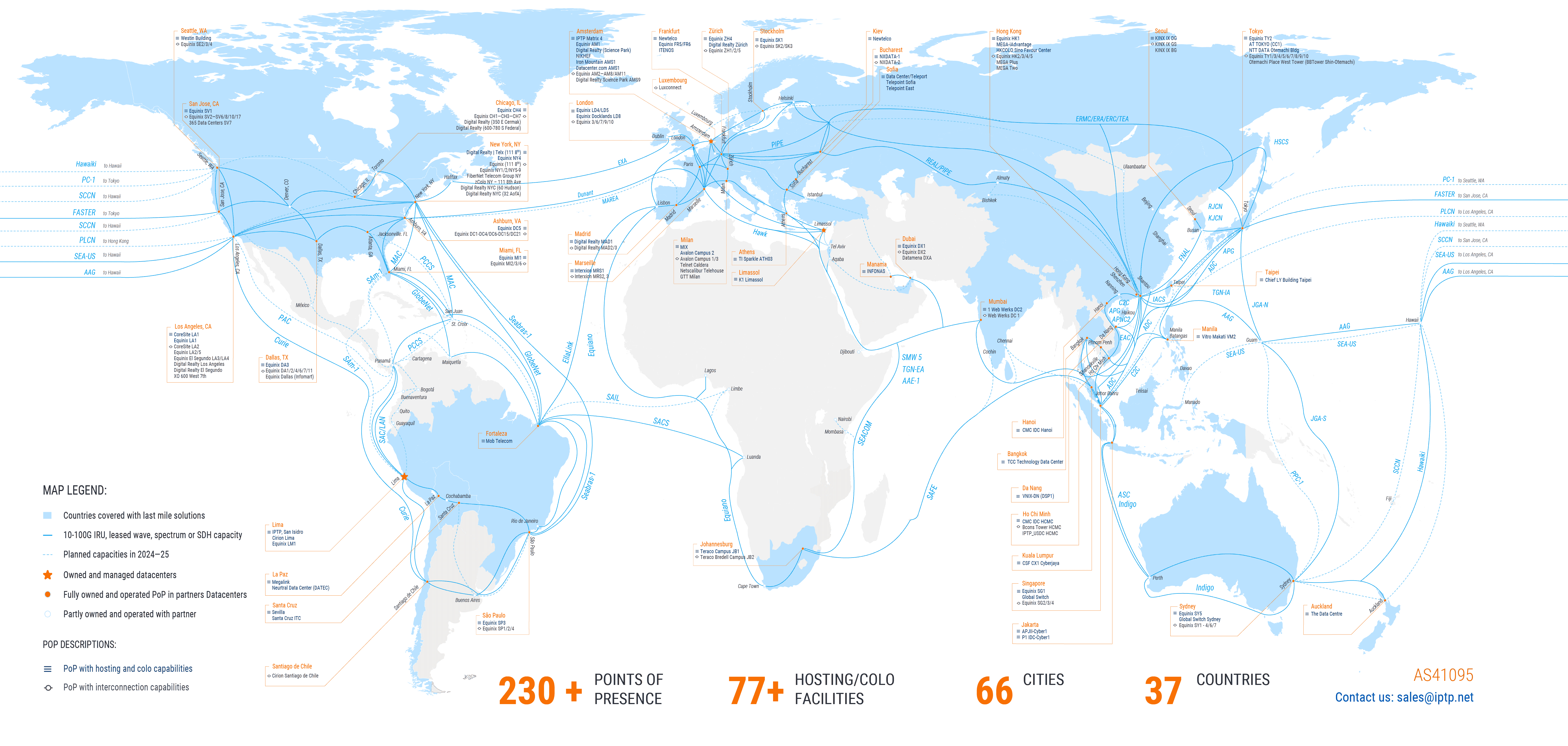
+Provisioning time depends on the last-mile and the service type. For on-net services, where IPTP infrastructure is already in place, delivery is on a Next Business Day (NBD) basis. IPTP currently covers over 230 on-net
locations. For off-net services, lead times depend on last-mile availability, access build-out and cross-connect completion at the relevant facility. Expedite delivery options can be discussed for time-sensitive requirements. We provide a target delivery date with each proposal.
11.
How is the service monitored and supported after handover?
+IPTP proactively monitors backbone utilization, availability, and service health around the clock from our NCC (Network Control Center). The NCC tracks anomalies, performance degradation, and availability events across the network, independently of individual SLA scope. Engineering staff are available 24/7 for incidents and changes. Customers receive periodic performance reports. Additional monitoring options and reporting scope can be defined in the SLA.